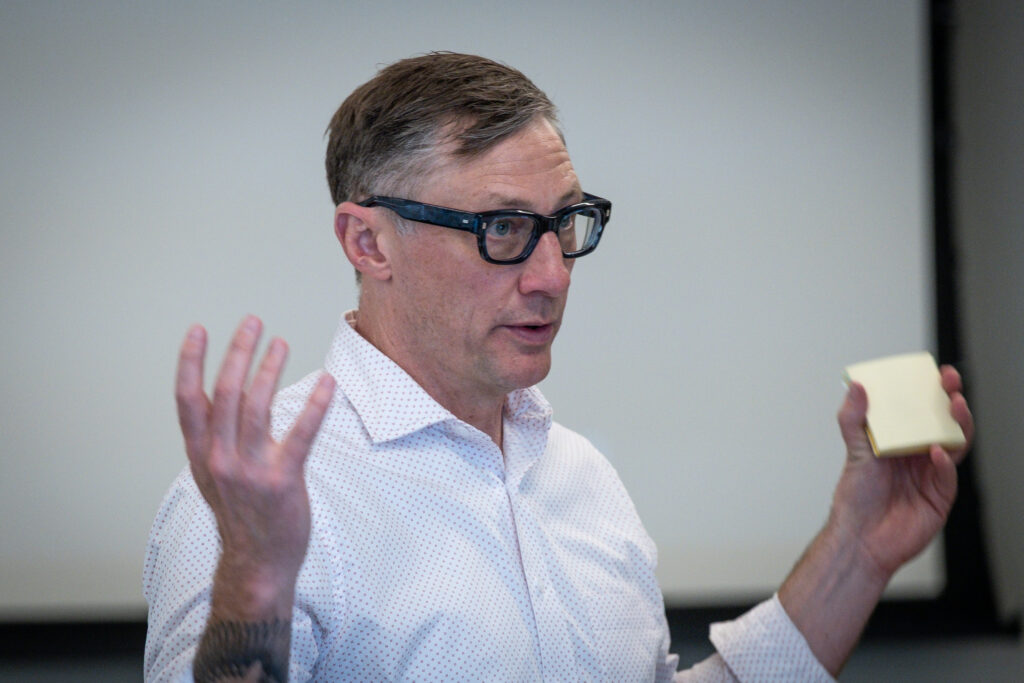
“I hate process improvement.”
That’s what my newest client said to me.
Well, that was a blow to my ego.
So I pressed, “Tell me—what about process improvement made you say that?”
She said that a facilitator had brought a dozen people into a room for four days of discovery and wrote on stickie notes for four days.
At the end of the four days, the facilitator said, “Thanks. But this process is a mess. And I think you should start over.”
This is just one of the stories I hear when we start engagements.
I wish it was a one-time thing or a unique anecdote. But unfortunately, I hear this chorus over and over again:
- “The facilitator did this or that and then was kinda rude about how we did our jobs.”
- “It took way too long.”
- “It was like a massive complaint session instead of a problem-solving exercise.”
We didn’t want to replicate Peak Academy when we created Change Agents training.
We wanted to create something new and different from all the things that we learned at Peak Academy.
We didn’t want to do the same things again.
We wanted to take all the things we discovered and make them better.
Change Agents was born on the failures, not on the successes.
No, please don’t misunderstand me—Peak Academy is incredible.
I am ridiculously grateful for everything we accomplished at Peak, but I didn’t want to build the same thing again and pretend that it was different.
Change Agents took all the great aspects as well as the misgivings and worked to make them even better.
Most process improvement programs struggle to get people through training and projects.
In fact, most programs typically experience a 25% graduation rate in training and a 30% success rate on projects.
I didn’t want to create another program or company with a 25-30% success rate.
We wanted it to be better. We wanted to do something different. We didn’t want people to have a bad experience with us.
The products and training that we build are results of failures, frustrations, and fatigue from our collective process improvement experience.
- It is why we don’t do 40-hour Rapid Improvements anymore.
- It is why we don’t sit in rooms for hours holding teams hostage to our process of discovery anymore.
- It is why we moved our trainings to an online Learning Management System (LMS).
Changing the way we perform our workshops and projects are all consequences of years of working through recurring problems.
The process improvement world needs to take a closer look at our customers.
We need to design a better experience without all the tedium.
We need to recognize that not everyone wants to be a Process Improvement (PI) expert.
Not everyone cares about the process—and that’s okay!
If we want to make real change, we cannot expect that the old way is going to work.
Sure, in some cases it does. But it means we still strike out 70% of the time.
It is the same focus and determination that we used when we created RVRWRK.
We didn’t build Coco to be cute and fun.
We built Coco to help get information from all the employees.
Not just the ones who show up to our process improvement project—but the ones that don’t care and the ones who are left out.
We want their voices to show up in the process anonymously.
We cannot build strong processes without dissent and without obstinate voices.
Those go into our system just like the ones who love what we do.
It is the voices that are positive and negative that help build stronger and more robust change.
No one goes to the Hall of Fame striking out 70% of the time.
We should be trying to achieve the opposite: a 70% success rate.
We didn’t set out to build a product with a 70% failure rate and somehow be excited if we get a few projects or graduates to use the tools and techniques in the future.
We set out to take the failures and turn them around.
In 2024, our Change Agents Graduation Rate was:
- Advanced Innovation (Black Belt) = 71%
- Problem Solving and Innovation (Green Belt) = 76%
- Building Transformers (White Belt) = 82%
This is not good enough for me.
I want this to get even better.
In 2025, I would love to see 80% across to the finish line.
You might be thinking that’s an overreach.
But for more than 4 years, we had a 100% graduation rate in Santa Barbara for the Advanced Innovation (Black Belt) course.
And I know it is possible.
Interested in chatting about your 2025 plans? Drop me a line here for a free consultation.