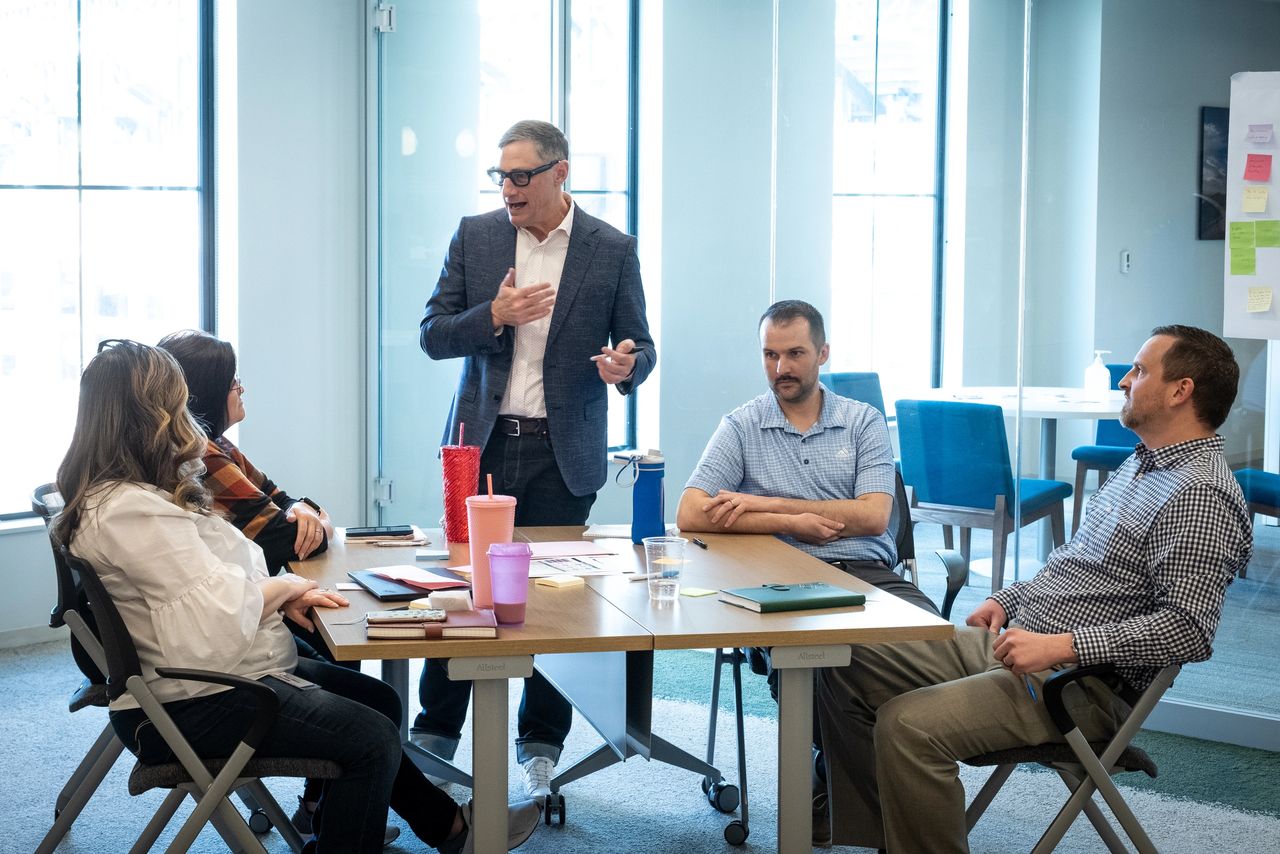
At the end of last month, I sat down to talk with Stephen Goldsmith, professor of urban policy at Harvard, former mayor of Indianapolis and former deputy mayor of NYC on the Harvard Kennedy School’s The Data-Smart City Pod.
With a resume like that, you’d assume panic isn’t part of the process…that government and innovation just flow.
But, that wasn’t necessarily the case…
This conversation ended up being two people unpacking what actually happens when government has to change and has to change fast.
Stephen opened up with the big picture:
“I do not think that very many initiatives of government have had as much of an effect on U.S. cities as what you did with Peak Academy in Denver. It has been replicated everywhere and has produced enormous change.”
I was floored. Truly. Had to collect myself.
The story? Denver was running out of money.
Peak Academy didn’t come from extra money in the budget. It came from a hard reality: fewer resources, fewer staff, and the same pothole blowing everyone’s tire.
So Denver had to ask a different question…
How can we keep helping people with less money?
How can we deliver services with fewer resources?
The answer is to focus inward, invest inward.
Provide someone with the right tools, show them that they can make direct change and they won’t stop.
Peak Academy focused on training city employees to improve service delivery themselves one process at a time. Employees were taught problem solving techniques, coached through challenges, and supported when they ran into barriers.
Because innovation isn’t always taught…it’s caught.
The goal wasn’t abstract ideas. It was practical improvement, rooted in day to day work.
And to everyone’s surprise…investing in the people that make the city clean, parks beautiful, that pothole filled, and your license renewed actually worked.
Peak Academy recently passed $50 million in government savings. Today, more than 60 governments run their own versions.
So…what’s next?
Stephen brought up the use of AI—how do we use these tools instead of scouring away from them?
How do we give people access to data without requiring them to be an analyst?
The biggest problem we had in Peak was not knowing what was going on in some departments. We had no “line of sight” to know what systems were being used, what processes existed…or didn’t.
Now using AI in government innovation, like our system Coco, allows people like me and other civil servants to perform their job easier.
How does Coco do this, you might ask?
Coco creates a living database of how an organization operates.
If we know what people do first thing in the morning when they sit down at their desk, or fire up a lawnmower, our ability to improve performance explodes.
This conversation keeps circling back to one thing: you don’t start with AI you start with belief, you start with a person, a marker, and a post it note.
People have to believe they can make improvements. That they’re not “just” clearing the street or “just” fixing a powerline. They are problem solvers.
Peak Academy understood that, Change Agents understands that, and so does rvrwrk.
The formula still holds:
- Be curious
- Let team members fail, let them make mistakes and help them when they do
- Live in a space where you are constantly improving
These three steps challenge your team to find useless work, get rid of it, and take a step back to see how you perform.
This is how you innovate. This is how change spreads.
Now go pick up that marker and call Coco.
Listen to Stephen and I’s full conversation here on The Data-Smart City Pod!
Actions speak louder than words.
Brian Elms
P.S. Last call for ICMA Innovation Bootcamp on February 17th. Spots are filling up quickly. Click here to join us!!!
P.P.S. Interested in learning about my new company, rvrwrk (River Work)? Drop me a line here, or even better, shoot me a reply to this email.
P.P.P.S. February 2026 soundtrack: